Friday, March 11, 2011

Massacre at Cawnpore

Vivian Stuart's Massacre at Cawnpore catches the reader by surprise. No matter what one's prior knowledge of the event, nothing can prepare the readers for the bloodshed described with a terrifying clarity. Stuart attaches her readers to a fictional member of the garrison at Cawnpore, Colonel Alex Sheridan, then drags them through the mud, under the burning sun, between musket fire, dodging cannon and the occasional bayonet on the way.
            Perhaps most disturbing about Stuart’s tale is the gradual jading of the readers. In the beginning of the tale, every death is described, given a name and a grieving family. But as the story progresses, death turns into a daily occurrence. Names are no longer given and casualties are presented as numbers rather than as people. The strength of the garrison slowly dwindles. Soldiers no longer have the strength to condemn General Wheeler for trapping them in their situation. They are dying off one by one, picked off by musket, cannon and heat alike.
            Despite the horror surrounding them, they fight on. After all, there are hundreds of women and children to be protected. Had it only been the men they might have been able to put together one last sortie and break through to Lucknow, but that was impossible with so many helpless people at their backs. And so they fought on, until they could fight no more. The Nana Sahib then offers them surrender, and Wheeler has little choice but to accept.
            With no option but to trust the Nana’s word, the exhausted defenders of Cawnpore pack up their things and make for the river. Just when they think they have made it to safety, the Nana’s men slaughter most of what was left of the men, taking the women and children hostage. Stuart has us follow Alex Sheridan, now delirious with lack of blood as well as grief and a concussion, makes his way to Allahabad. We join the march to take back Cawnpore, and just when we think the suffering is finally over, the Nana orders the hostage women and children murdered.
            And this is where Stuart springs empathy back upon her readers. After an entire novel of making her audience accustomed to death and tragedy, this last violence truly shatters whatever composure may be had. Told simply and unadorned, without names or details, the true massacre at Cawnpore is a horror so real that there is nothing to be done but mourn.
            Truly heart-wrenching and poignant, Stuart’s portrayal of the horrific tragedy at Cawnpore is enough to stir even the stoutest of hearts.

Sunday, February 20, 2011

I Remember Nelson

"I Remember Nelson" was a short, less-than-brilliant film plagued by the common problems of made-for-TV movies. From the perspective of a common gunner on the HMS Victory, the film attempts to portray how this great man was remembered by his common sailors. All in all, it falls short of the mark, delivering a rather choppy version of events made worse by bad acting and even worse effects. Disregarding these faults, the story itself is interesting. Being privy to Nelson's final words and seeing his last moments brings forth empathy, despite the less than astounding theatrical performance. The film brings the ordinariness back to Nelson, cutting through the aura of brilliance and exposing the mortal within. Whatever the repercussions the death of this great man on a global scale, his last breath is still that of a dying man, great or small, important or obscure.

Saturday, February 19, 2011

Ramage at Trafalgar

            Dudley Pope’s Ramage at Trafalgar is a well-written fictional account surrounding the pivotal victory in England’s defeat of Napoleon Bonaparte. Pope creates a likable character that his readers are quickly drawn to. Despite being the 16th book in a very long series, the tale is isolated and interesting without relying on previous events.
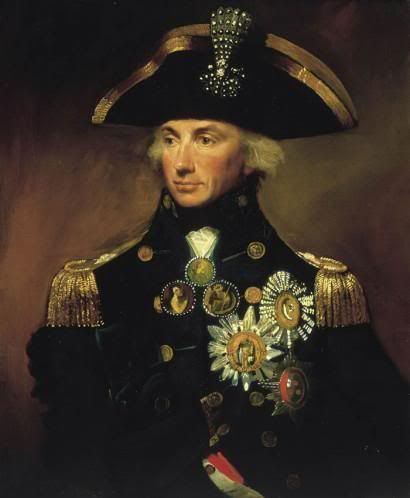
Horatio Nelson
            Pope first introduces Lord Nicholas Ramage at the reading of his uncle’s will. Ramage is quickly established as an intelligent and sensible man, without the pomp and arrogance of his contemporaries. His wife, Sarah, is also present at the reading. Recently married and obviously quite happy, the Ramages have a surprisingly modern relationship. Sarah seems to possess certain frankness that is absent in most women of the time, making her more relatable to Pope’s readers.
            Pope takes his story a step further. On top of creating likable fictional characters, he personally introduces his readers to the legendary Horatio Nelson. Bringing this naval hero down from legend is a difficult task, one that Pope does with surprising skill. He even gives a good look at Nelson’s mistress, Lady Emma Hamilton, widow of his friend Lord Hamilton and mother of his “goddaughter,” Horatia Nelson Thompson.
Pope’s characters voice their opinions concerning Nelson and his mistress. Nicholas holds the greatest respect for the commodore, and Sarah likes his wife so much, she stands up for Lady Hamilton at dinners where gossip runs rampant.            
            Beyond the social atmosphere is the actual battle of Trafalgar. Pope creates an advantageous read by creating a character with authority and feeling to observe and participate in such a monumental event in history. Having Nicholas Ramage pick a fight with a French frigate is adventurous in and of itself. He creates a somewhat suspenseful turn of events, having Ramage’s frigate, the Calypso, break through the line following one of his own ships of the line. The short scuffle with the French frigate is exciting and well written, including the nerve-racking turnabout to use the Calypso’s sister ship as a shield against the French ship of the line intent on blowing Ramage’s boat out of the water.

The HMS Victory

            But perhaps most important concerning Pope’s fictional work is the witness to the death of Nelson. By creating a character with a vested interest in all that occurred, both in battle and afterwards, Pope gave true insight into what it was like to come to the realization that the great Nelson had died. The undeniable certainty, knowing what it means to have Nelson’s flag hauled down from the Victory’s mast. How unfair, how cruelly ironic, that the great commander had been shot down in his moment of triumph, his greatest foe defeated.
            Pope gives his readers a lens to the past, blurred by the tears of Nelson’s admirers and faithful soldiers. Through it, one can truly appreciate the man behind the medals and titles.

Monday, February 14, 2011

Master and Commander

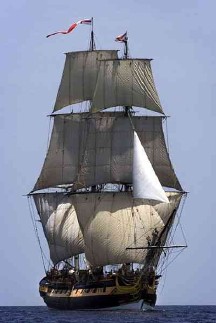
Master and Commandergives a cinematic look into the duty of a British ship during the war with Napoleon. Led by the strong and stubborn Captain “Lucky Jack” Aubrey, the HMS Surprise is given orders to hunt down the French ship, Acheron, to prevent her from stretching Napoleon Bonaparte’s reach to the far side of South America.
HMS Surprise
            Aubrey quickly realizes that he’s outgunned and outmaneuvered by the French ship, as it sneaks up behind the Surprise in a fog and delivers a pounding to the British ship. Aubrey manages to lose the Acheron in the fog with a clever ruse involving a miniature ship with lanterns aboard floating away from the Surprise. After repairing his ship, Aubrey resumes the pursuit, seemingly more because of the insult to his person and ship rather than his duty to his country.

            The wisdom of this chase is questionable, as the Acheron hides in a bay in the coast and sneaks behind the Surprise once again. Aubrey and his crew manage to escape yet again, and “Lucky Jack” vows that there will not be a third such encounter. His brilliant idea to capture the French vessel is inspired by his friend, Stephen, explaining how a stick bug evolved to look like a stick in order to evade predators.

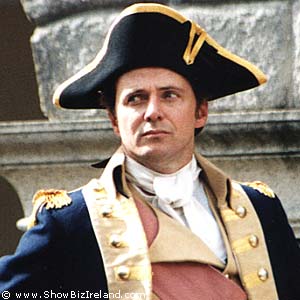
Jack Aubrey, played by Russell Crowe

            The fascinating deception that Aubrey pulls off is truly quite amazing. Disguising his ship as a whaler, Aubrey basically orders his ship to sit and wait, drawing the Acheron to him before running out the guns and beating her into submission.
            The movie was engaging and suspenseful, as well as clever and intelligent. The sound and effects were astonishingly realistic, adding to the overall feeling of dashing headlong into the Pacific Ocean after a ghost of a ship.

Thursday, February 3, 2011

Benedict Arnold: A Question of Honor

Although this made-for-TV movie is slightly lacking in both effects and actor talent, the story of the great American traitor is told in its entirety fairly eloquently. Many Americans know Benedict Arnold only as a traitor. Few know the circumstances that drove him to treason.
Arnold is clearly depicted as a fiery and stubborn man, quick to anger and even faster to challenge offenders to a duel. His actions at Saratoga make him a hero, but his praise is bestowed upon his superior officer, Horatio Gates, whose orders he had to defy to win the day. Shot in the leg and permanently crippled, the wound is clean but bitterness festers in his soul.
The film portrays Arnold’s increasing frustration with Congress and his country with surprising skill. When George Washington makes Arnold the military governor of Philadelphia, his anger is appeased somewhat, and he sets about doing what is asked of him: diffusing tension between Loyalists and rebels. The movie makes his unconventional solution to this problem, a banquet, amusing as well as tense, probably an accurate depiction. The only point on which a viewer may be critical is Arnold’s excessive and, to be honest, sickening flirtatious nature when around the future Mrs. Arnold. Yes, he was infatuated. No, the producers did not do well in attempting to duplicate his 18th century pick-up lines.
As a whole, Arnold’s bitterness was well-shown throughout the film. Knowing the inevitable conclusion only made it more horrible to watch General Washington hand over West Point to his most trusted officer. Mrs. Arnold’s influence was certainly marked. Had it not been for her, Benedict Arnold may very well have died an American hero. But then again, the film made a psychic out of Arnold’s British commander by having him comment that Arnold’s betrayal had united the country in a way that would ensure its eventual victory over Great Britain.
All in all, “Benedict Arnold: A Question of Honor” was an interesting watch if not brilliantly filmed.

Monday, January 31, 2011

The Fort


In Bernard Cornwell’s The Fort, the fledgling nation of the fragile United States of America is portrayed in a less than favorable light. This historical novel describes in painful detail the biggest naval blunder in American history. The Penobscot Expedition is little-known, and not discussed in most history books. Cornwell drags this small battle from the shadows of the past.
A small contingency of 700 Scotsmen arrived in the wilderness of what is now Maine in the summer of 1779, with the single purpose of standing between the rebels and Canada. Then part of Massachusetts, Majabigwaduce would be a name to make American leaders cringe in the years to come. The state government of Massachusetts, determined to deal with the British infestation without interference from the Continental Congress, assembled the largest rebel fleet to date. Forty-two ships set sail to ‘captivate, kill or destroy’ the redcoats. This astonishingly sized naval force was powered by only 900 men, many of whom were forced into service so that their state need not borrow soldiers from the nation.
Led by possibly one of the most incompetent commanders in history, General Solomon Lovell, one could argue that the expedition was doomed from the beginning. Lovell was no general. A community man, well-liked and personable, but a military man he was not. He had no control over his troops, commanded no respect, and often backed out of a necessary fight. His second-in-command, Brigadier-General Peleg Wadsworth, was beyond exasperation by the end of the less-than-successful undertaking.
Lovell’s co-commander, Commodore Dudley Saltonstall, would be Massachusetts’ scapegoat when all was said and done. Combative and gruff, Saltonstall was not known for his disposition. However, any participant in the Penobscot Expedition, were they here to tell us, would vouch for the commander of the ships. It was Lovell’s lack of action that cost the Americans precious time. Instead of attacking immediately upon arrival, the general ordered his troops to make camp. This gave the Scotsmen plenty of time to build up their pitiful Fort George. As days passed without an assault, the walls of the fort grew higher and more defensible. As time wore on, Saltonstall refused to enter Penobscot Bay, defended by three British sloops of war, until the fort was taken by Lovell and the soldiers.
Saltonstall was not unreasonable with this demand. His logic was infallible. If the fort is taken, the ships are doomed anyway. Had he attacked the ships before the taking of the fort, the guns atop Dyce’s Head would surely have reduced his ships to so much timber. Lovell’s concerns were unfounded. His worry was that the sloops of war in the bay would attack his men in their ascent to the fort. Of course, in the end they argued so long that their time was squandered and British reinforcements arrived.
Cornwell does a spectacular job comparing the two commanders, Lovell of the land battle and Saltonstall of the sea. He presents both men in this high-pressure situation and truly unweaves the tangled mess that surrounds both the men and their expedition. His readers are confident in their knowledge that Lovell condemned the mission to failure. However, Massachusetts saddled Saltonstall with the blame, as he was the only Continental commander involved. By blaming the federal government’s asset, Massachusetts weaseled its way out of paying for the exorbitant cost of the failure, a sum that would be equivalent to around $300 million today.
History may have forgotten Saltonstall, as well as the expedition that was his downfall, but Bernard Cornwell exonerates the prickly commodore and points the finger at the person responsible, General Solomon Lovell.